In Turin there are streets that, for a stretch, pass under a roof of iron and glass. You go in on one side of the block and come out on the other, among shop windows, shops and cafés. The idea comes from the Parisian passages, widespread in France from the end of the eighteenth century and arriving here in the second half of the nineteenth, together with the transformation of the centre and the growth of trade.
Three of these historic arcades remain: the Subalpina, inaugurated in 1874, the Umberto I, opened in 1890, and the San Federico, built in the 1930s. They differ in age and architecture, and also in the way they fit into the city.
Starting from the B&B, in Borgo Po, cross the river and follow the porticoes of via Po to piazza Castello. From there you go on to the Subalpina, then to the San Federico near via Roma, and finally to the Umberto I, on Porta Palazzo, at the edge of the Quadrilatero Romano. It is a walk entirely on foot: about an hour of actual walking, but we advise you to keep at least a couple of hours to look at the interiors, the decorations and the shop windows. In the covered stretches you also shelter from the rain; between one arcade and the next, however, you are back in the open. Before setting out, check for any changes in access.
On foot Walking: 3.3 km, 49 min
-
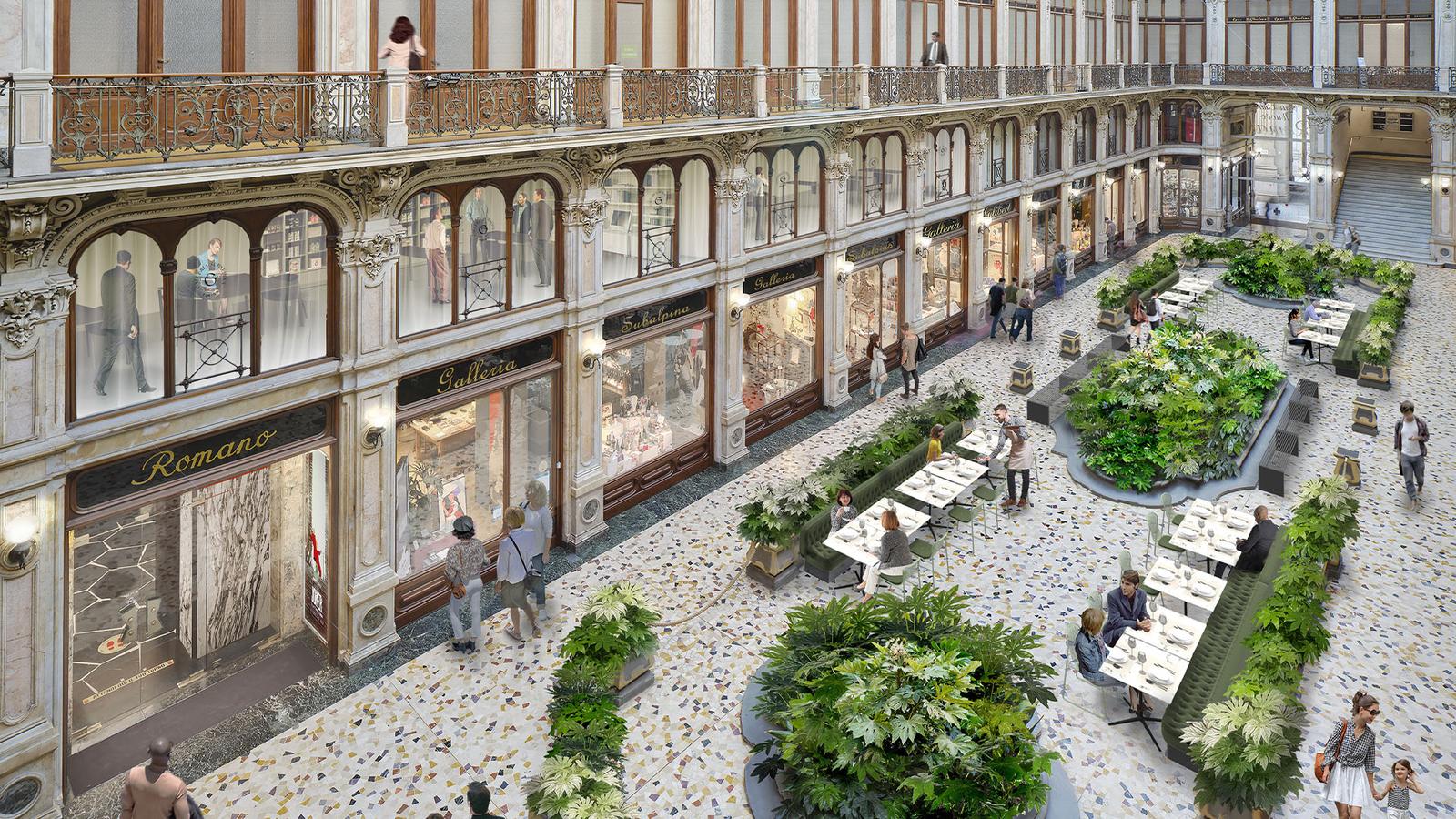 Galleria Subalpina
Between piazza Castello and piazza Carlo Alberto you can walk through the Galleria dell'Industria Subalpina, passing beneath a great vault of iron and glass. It is one of those places where it comes naturally to slow down and look around.
Read more
It was designed by Pietro Carrera in 1873 and opened in 1874, modelled on the Parisian passages. The balconies, the inner shopfronts and the eclectic decorations mix Renaissance and Baroque references, in keeping with nineteenth-century taste.
The gallery has a long commercial tradition, above all tied to books: here you will find antiquarian bookshops such as La Casa del Libro and Gilibert. There are also the confectioner Baratti & Milano, which moved here in 1875, and the Cinema Romano.
The Parisian passages were conceived to combine shopping and strolling in covered spaces, lit from above and sheltered from the weather. The Galleria Subalpina takes up the idea, gathering shops, cafés and meeting places along a single route.
Among the businesses that have marked its history are Baratti & Milano, whose interiors were renewed in the early years of the twentieth century, and the Cinema Romano, heir to the old Caffè Concerto Romano. The Lumière cinematograph was already here in 1905.
-
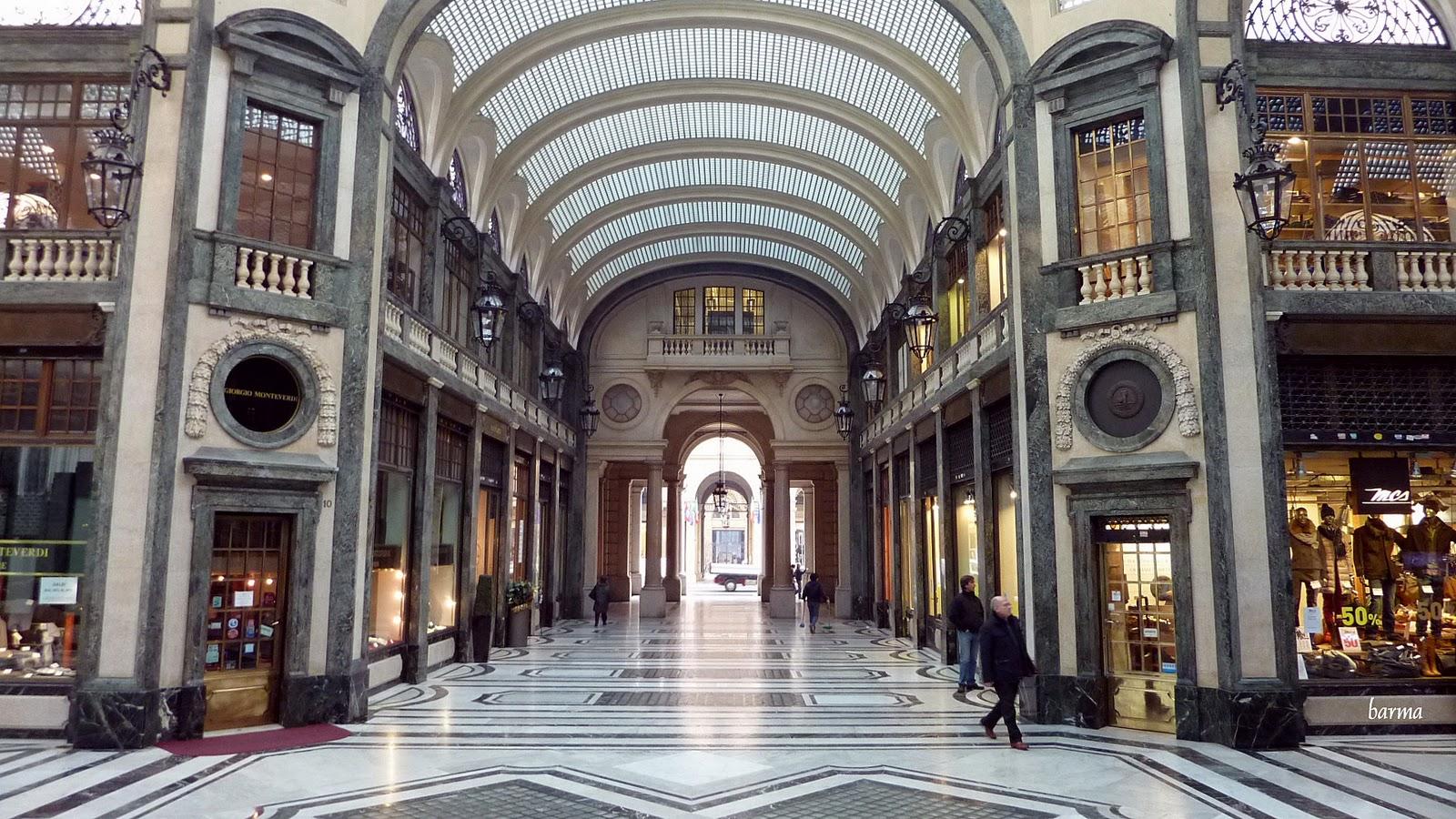 Galleria San Federico
From via Roma you enter a T-shaped space, with shops on the ground floor and offices on the upper levels. The Galleria San Federico links via Roma to via Bertola and via Santa Teresa: it was built in 1933, during the reconstruction of via Roma, to a design by the engineers Giovanni Canova and Vittorio Bonadè Bottino. The name takes up the old name of the block.
Read more
The geometries and decorations reflect the taste of the 1930s; above, glass-block roofing and domes at the entrances. There is also a cinema: the Lux, opened in 1934 as the Rex, then called the Dux and finally the Lux since 1945. The entrance and the decorations deserve a look even if you are only passing through.
Before the present gallery, this was the site of the Galleria Natta, later called Geisser, built in the nineteenth century. The San Federico therefore tells of a second life of the covered shopping passage, rethought during the transformation of via Roma.
If you have already seen the Galleria Subalpina, the comparison comes naturally: here the spaces are more regular in their geometry, the roofing has a different structure and the cinema has become part of the shopping route. Two ways of understanding a space created for crossing the city under cover.
-
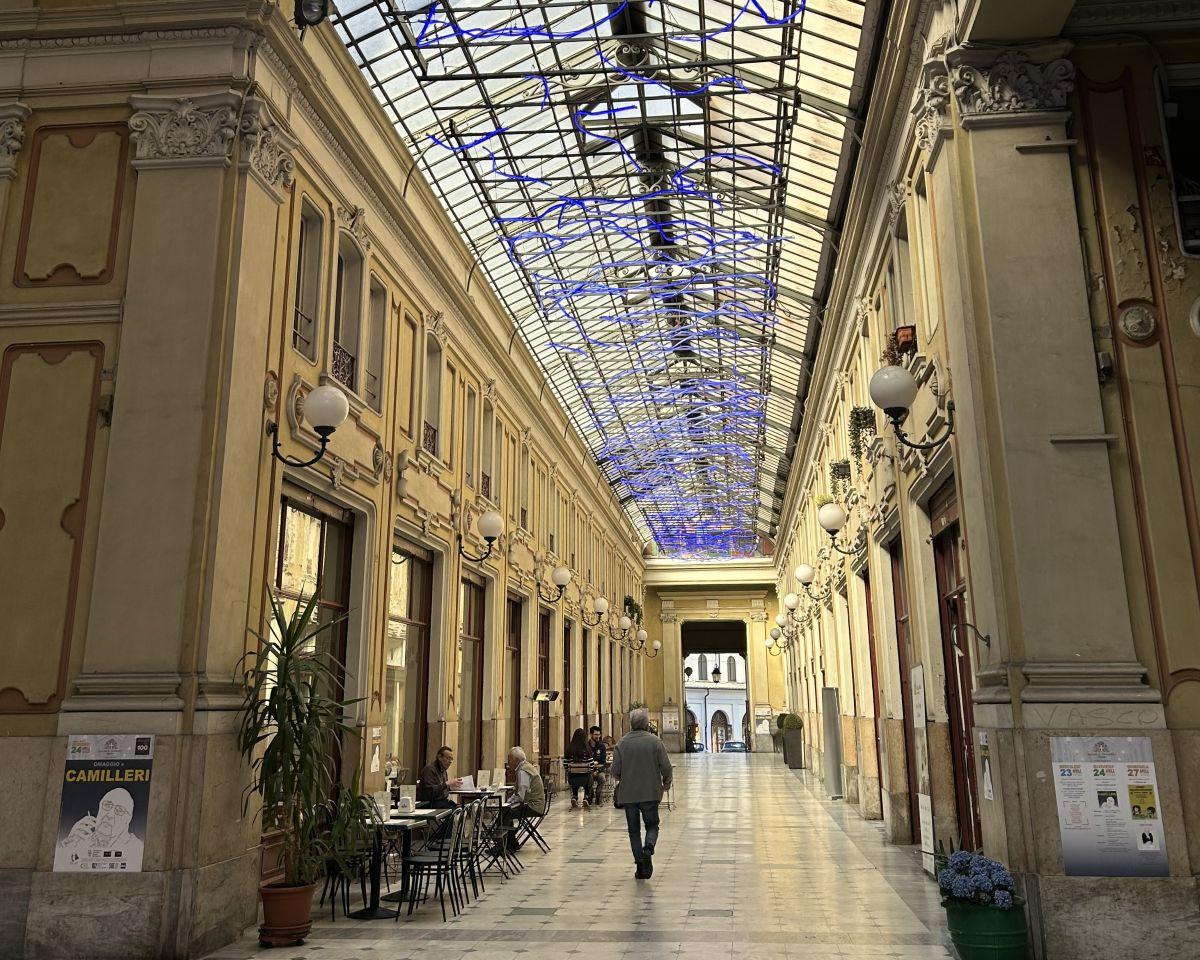 Galleria Umberto I
In Galleria Umberto I the light comes from above, through the glass and metal roof, and is reflected on the marble floors. All around are the shops, but it is above all the cross-shaped plan that gives the space its character: when you reach the crossing of the arms, the perspective changes. Completed in 1889, the gallery retains the atmosphere of nineteenth-century Turin. It has also been a film set, for «Trevico-Torino: Viaggio nel Fiat-Nam» by Ettore Scola, shot in 1973, and for «Così ridevano» by Gianni Amelio, from 1998.
-
Galleria Umberto I
Galleria Umberto I
In Galleria Umberto I the light comes from above, through the glass and metal roof, and is reflected on the marble floors. All around are the shops, but it is above all the cross-shaped plan that gives the space its character: when you reach the crossing of the arms, the perspective changes. Completed in 1889, the gallery retains the atmosphere of nineteenth-century Turin. It has also been a film set, for «Trevico-Torino: Viaggio nel Fiat-Nam» by Ettore Scola, shot in 1973, and for «Così ridevano» by Gianni Amelio, from 1998.
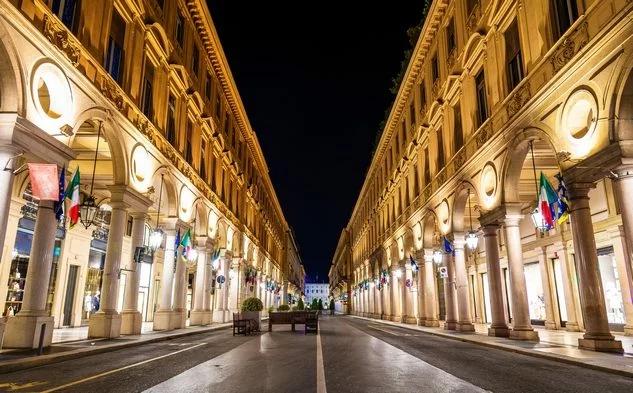
The route
The map loads after consent to third-party content (OpenStreetMap).
These are the essential stops, but there is much more
When you book your stay with us you receive the complete step-by-step itinerary, a practical box with directions to get there and back, tips on what to see and a final treat to round off the themed day.